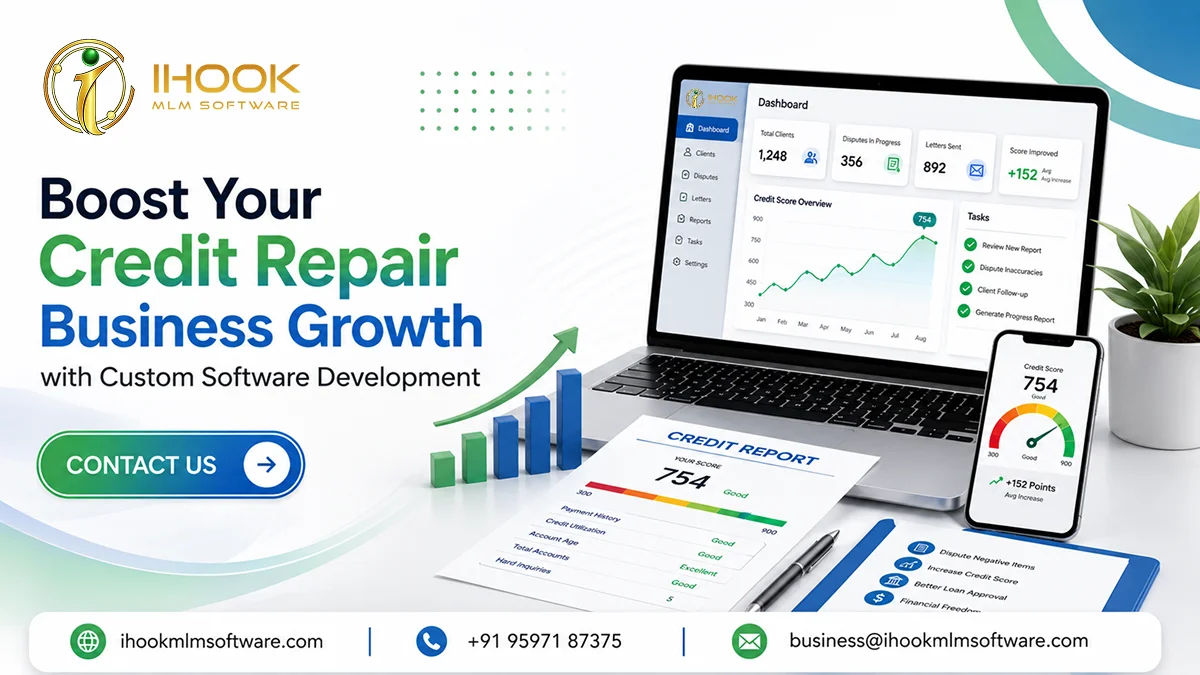
Credit repair services depend much on the organized client data, prompt follow-ups, document management, work process optimization, and constant communication. When the business develops, managing all these things via Excel sheets, e-mails, and other separate tools becomes quite complicated. In some cases, the manual approach can take up much time and make it more challenging for the teams to keep track of the clients' ongoing activity.
There is an option to create custom software development to manage all these processes in one digitalized environment. Rather than trying to fit the business processes into the generic programme that already exists, one can develop the technology according to their needs and goals.
What Is Custom Software Development for Credit Repair Businesses?
Custom software development involves creating a digital platform specifically around the requirements of a particular business. For a credit repair company, this can include client management, workflow tracking, document organization, communication, reporting, and administrative functions within one system.
In contrast to standard software which comes with prebuilt functionality, a custom-built platform can be built in accordance with the way a company does its business. It enables prioritizing the necessary functionalities, integrating the appropriate third-party services, and building workflows accordingly.
Credit repair business software development can therefore focus on solving specific operational challenges instead of adding unnecessary functionality.
Why Do Credit Repair Businesses Need Custom Software?
As client volumes increase, maintaining information across multiple systems can make everyday operations more complicated. Teams may need to track client details, organize documents, monitor tasks, respond to requests, and maintain records at the same time.
A customized digital platform can bring these activities together in a structured environment. Businesses can create centralized workflows for managing client information, assigning tasks, monitoring progress, and handling routine administrative activities.
Another important advantage is flexibility. A small business may initially require only essential functions, while a growing organization may later need advanced reporting, integrations, additional user roles, or automated workflows. Custom technology can be planned with these future requirements in mind.
Key Credit Repair Software Features
The effectiveness of a business platform depends largely on whether its functionality addresses real operational requirements. Some important credit repair software features include:
Client Management
A centralized client management system can store customer profiles, activity records, communication history, tasks, and relevant documents in one location. This helps teams find information without switching between multiple applications.
Workflow Management
Workflow tools can help businesses organize tasks, assign responsibilities, monitor statuses, and identify activities that require attention. Structured workflows can make daily operations more consistent.
Document Management
Credit repair businesses often handle different types of client documents. A dedicated document management system can help organize files, control access, and make relevant information easier to retrieve.
Communication Management
Integrated communication features can help teams manage reminders, notifications, follow-ups, and communication records. Keeping interactions organized can improve internal coordination and client service.
Reporting and Analytics
Business dashboards can provide visibility into operational activities, task progress, client activity, and other important metrics. Reports can help management identify bottlenecks and make better-informed decisions.
User and Access Management
Different employees may require different levels of access. Role-based permissions can help organizations control which users can view or manage particular areas of the platform.
Benefits of Credit Repair Business Automation
Automation can reduce the amount of repetitive administrative work performed manually. Instead of depending on employees to remember every routine activity, businesses can establish structured workflows for recurring tasks and notifications.
One of the main advantages of credit repair business automation is improved operational consistency. Standardized processes can help teams follow the same workflow across different client accounts.
Automation can also improve productivity by allowing employees to spend more time on activities that require human judgment and communication. Centralized information can further reduce the time spent searching through separate systems.
However, automation should be implemented selectively. Not every process needs to be automated. Businesses should first identify repetitive, rule-based activities where automation can provide measurable operational value.
Credit Repair Software Development Process
A successful project begins with understanding the business rather than immediately building features. The credit repair software development process generally includes several important stages.
1. Requirement Analysis
The development team first studies the company's workflows, users, business objectives, and operational challenges. This stage helps determine what the platform actually needs.
2. Feature Planning
Once requirements are understood, features can be prioritized. Businesses can separate essential functions from advanced capabilities that may be introduced later.
3. UI/UX Design
The interface should be designed around usability. Clear dashboards, simple navigation, logical workflows, and accessible information can make the platform easier for employees to use.
4. Software Development
Developers then build the required frontend, backend, database architecture, APIs, and integrations. The technology stack should be selected according to the project's performance, scalability, security, and maintenance requirements.
5. Testing
Testing should cover functionality, usability, performance, security, integrations, and different user scenarios. Identifying issues before deployment can reduce operational problems after launch.
6. Deployment
After testing and approval, the platform can be deployed to the production environment. Proper configuration, access management, backups, and monitoring should be considered during deployment.
7. Maintenance and Improvements
Software development does not necessarily end at launch. Businesses may require updates, performance improvements, security enhancements, new integrations, and additional features as their requirements change.
Security Considerations for Credit Repair Business Software
Security should be taken into account at the outset of the development process, especially if there are platforms that contain critical customer and company data.
Some of the important factors include proper authentication, role-based access, encryption, secure document management, auditing, backup methods, and secure API communication.
It would be advisable to also take into consideration the manner by which data collection, storage, retrieval, transmission, and retention are being conducted. The security requirements should align with the legal and regulatory requirements of the business instead of general security promises.
A secure platform cannot be achieved through just one security feature.
How Custom Software Can Support Business Growth
Technology can contribute to business growth by improving the efficiency of existing operations. When information is centralized and workflows are organized, teams can spend less time managing repetitive administrative activities.
A well-designed platform can also provide better visibility into daily operations. Management can identify workflow delays, monitor performance, and determine where additional improvements may be needed.
The goal should not simply be to build more features. The goal is to create technology that solves genuine business problems and remains useful as the organization expands.
In simple terms:
Organized information → efficient workflows → reduced manual effort → better operational control → easier scalability
Custom Software vs. Generic Tools
Both custom and generic software can be useful, depending on the business's requirements.
| Feature | Custom Software | Generic Tools |
|---|---|---|
| Workflows | Designed around specific workflows | Uses predefined workflows |
| Functionality | Flexible functionality | Standard feature sets |
| Integrations | Custom integrations can be developed | Limited to available integrations |
| Interfaces | Tailored dashboards and interfaces | Standard dashboards |
| Scalability | Can be planned for specific scalability needs | Scalability depends on the provider |
Businesses should evaluate the total operational requirement before choosing either approach. Custom development may be more suitable when existing tools cannot support important workflows or when long-term flexibility is a priority.
Final Thoughts
Custom software can help credit repair businesses organize information, automate suitable workflows, improve team productivity, and create a scalable technology foundation. The most effective solution starts with clear requirements rather than simply adding a large number of features.
Businesses considering credit repair business software development should evaluate their current processes, future requirements, security needs, integrations, and expected users before beginning development. A structured credit repair software development process can then turn those requirements into a practical and maintainable digital platform.
For businesses looking for customized software solutions, IHook MLM Software can help with planning and developing tailored digital platforms based on specific business requirements.
Frequently Asked Questions
1. What is custom software development for a credit repair business?
It is the process of developing software specifically around a credit repair company's workflows, users, operational requirements, integrations, and business objectives.
2. What are the most important credit repair software features?
Common features include client management, workflow tracking, document management, communication tools, reporting dashboards, notifications, user management, and appropriate security controls.
3. How long does credit repair software development take?
The timeline depends on the project's scope, number of features, integrations, design requirements, testing needs, and development complexity. A clearly defined MVP can generally be planned separately from advanced future functionality.
4. How can custom software improve credit repair business operations?
It can centralize information, reduce repetitive administrative work, organize workflows, improve internal visibility, and help teams manage growing operational requirements more efficiently.
5. How much does custom credit repair software development cost?
There is no single fixed price. Cost depends on the required features, platform type, UI/UX complexity, integrations, security requirements, development scope, and ongoing maintenance needs.